

What to Wear Under a Ready-to-Wear Saree: A Practical Guide for Diaspora Women in the USA
The layer nobody talks about
You found a gorgeous ready-to-wear saree, ordered it, and it arrived looking exactly like the photos. Then you put it on — and something's off. The pleats look bunchy, the fabric keeps shifting, and the whole silhouette feels a little deflated. Nine times out of ten, the problem isn't the saree. It's what's underneath it.
The underlayer is the most skipped step in the ready-to-wear saree conversation, and it matters more than most people realize. It determines how cleanly the pleats fall, whether the pallu stays anchored, and whether you look polished in photos or like you're fighting your outfit all evening.
This guide covers exactly what you need — and what you can skip — when you're dressing for a saree occasion in the USA.
First: How a ready-to-wear saree is different from a draped one
A traditional saree is six to nine yards of fabric that gets hand-draped and pinned around a petticoat. The petticoat is structural — it's literally what the pleats are tucked into and what holds the whole drape together.
A ready-to-wear (pre-stitched) saree has already been shaped for you. The pleats are pre-set, the pallu is attached, and you typically step into it and fasten it at the waist — no draping required. That's the whole appeal, especially if you're in the USA and don't have someone nearby to drape it for you. (Wondering if a ready-to-wear saree is the right choice for you? This breakdown is worth reading first.)
Because the structure is already built in, your underlayer job changes. You're no longer using a petticoat to anchor pleats. Instead, you need something that creates a smooth base, keeps the saree from sliding, and gives your silhouette a clean, even shape.
Option 1: The traditional petticoat
A traditional petticoat — the long, drawstring-waist underskirt — still works under a ready-to-wear saree, with some caveats.
It's a good choice when your saree is made from a heavier, more structured fabric that doesn't cling. Cotton, silk, and thicker georgette sarees sit well over a petticoat without showing lumps. The petticoat adds a layer of modesty and gives the saree something to rest against.
Where it falls short: petticoats made from stiff or cheap fabric can create visible ridges under lighter, more sheer sarees. The drawstring waist can also bunch under a fitted blouse, and if the petticoat color doesn't closely match the saree, it can show through at the slit or hem. For a pre-stitched saree with a side slit, a traditional petticoat can also limit your stride more than you'd like.
If you go the traditional route, match the petticoat color to your saree as closely as possible, and make sure the length hits just above your ankle — not mid-calf, which throws off the whole proportion.
Option 2: Saree shapewear — and why it's worth considering
This is where things have genuinely improved for saree wearers in the last few years. Saree shapewear petticoats — like the NYKD Seamless Saree Shapewear (NYSH01) available at India Ethnicity — are designed specifically to solve the problems a traditional petticoat leaves behind.
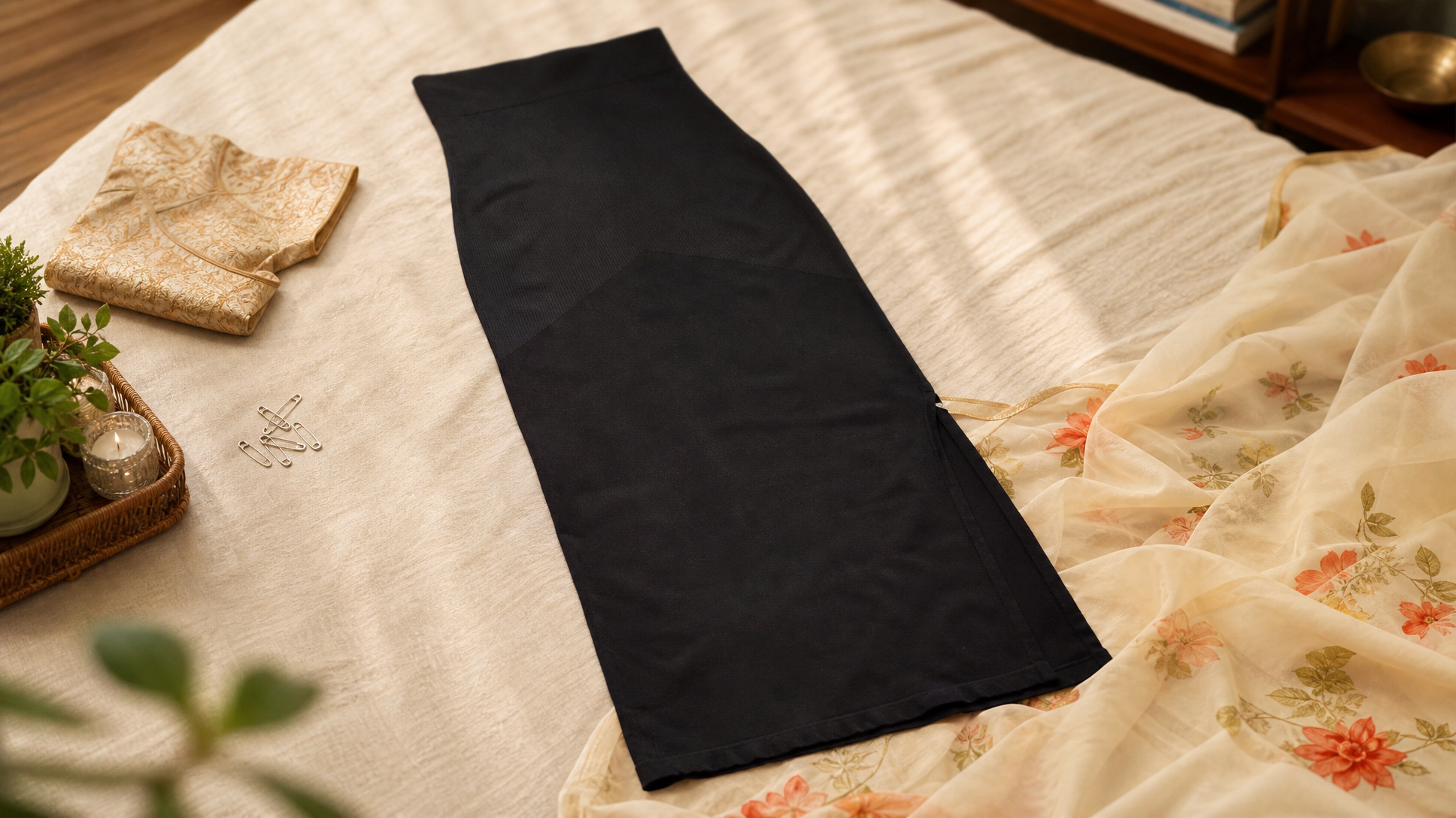
The NYKD piece is made from a nylon-spandex blend, which means it stretches to fit your body rather than sitting rigidly around it. It has a seamless construction, so there are no visible lines under sheer or semi-sheer saree fabric — a real issue with traditional petticoats that have seams running down the sides. The wide elasticated waistband sits flat under a blouse or crop-style saree top without bunching, and targeted compression on the hip area gives the saree something smooth and even to drape over.
The side slit is a practical detail that often gets overlooked: it means you can walk, climb stairs, and yes, dance at a wedding without feeling like your legs are tied together. For a ready-to-wear saree that already has a built-in slit, this aligns perfectly.
Buyers who've worn it consistently mention two things: the comfort holds up through a full event, and the silhouette it creates under a saree is noticeably cleaner than what a traditional petticoat delivers. It's also worth noting that the shapewear works beyond sarees — it functions well under lehengas or fitted ethnic gowns if you want a streamlined look for those too.
It comes in black (anthracite), and the seamless finish in a dark neutral means it disappears under most saree colors without any risk of show-through.
Which one should you actually choose?
Here's an honest way to decide:
- Go with a traditional petticoat if your saree is in a heavier, opaque fabric, you already own a well-fitting petticoat in the right color, and you prefer a more traditional foundation layer.
- Go with shapewear if your saree is sheer or lightweight, you want a smoother silhouette, you're going to be on your feet for hours, or you've had the bunching-petticoat problem before and want to solve it once and for all.
- Either works if your saree is mid-weight and fully opaque — in that case, comfort and personal preference should drive the decision.
One thing that's rarely worth doing: wearing a regular skirt or legging underneath and hoping for the best. Neither is designed for saree movement, and both tend to create exactly the kind of visible lines and shifting fabric that make a saree look untidy.
What about underwear?
Keep it simple and seamless. Visible panty lines under a fitted saree silhouette are easy to avoid — just choose a seamless brief or a thong in a color that matches your skin tone. Avoid anything with thick waistbands that might show above the saree waistline, especially if you're wearing a shorter blouse. This is a small detail that makes a noticeable difference in how put-together the overall look is.
A note on blouses
Your blouse is technically not an underlayer, but it affects how the whole outfit sits. A blouse that's too loose at the midriff lets the saree fabric shift. One that's too tight restricts how cleanly the pallu drapes over the shoulder. For a ready-to-wear saree, a well-fitted blouse — even a simple one — does more for the final look than any amount of pinning and adjusting after the fact. If you're buying a saree from abroad, check whether a blouse piece is included or whether you'll need to source one separately. (The first-time saree wearer's checklist covers this and other prep steps in detail.)
The bottom line
A ready-to-wear saree makes the draping part easy. Don't let the underlayer undo that. Get the foundation right — smooth, well-fitted, and movement-friendly — and the saree does the rest of the work for you.
Shop ready-to-wear sarees and the NYKD Seamless Saree Shapewear at India Ethnicity — shipped directly from India to your door in the USA.
Frequently Asked Questions
Can I wear a regular slip or skirt instead of a petticoat under a ready-to-wear saree?
It's not recommended. Regular slips and skirts aren't designed for saree movement, and they tend to shift, bunch, or create visible lines under the saree fabric. A proper petticoat or saree shapewear petticoat is shaped and weighted to work with the saree — a regular skirt isn't.
Does the petticoat color matter under a ready-to-wear saree?
Yes, especially if your saree fabric is sheer or semi-sheer. A petticoat that's much lighter or darker than your saree can show through, particularly at the hem and any slits. Match as closely as you can, or choose a neutral shapewear in black or nude that blends with most saree colors.
Is saree shapewear comfortable enough to wear for a full wedding or festival event?
The NYKD seamless shapewear is specifically designed for extended wear — the nylon-spandex blend stretches with your body rather than constricting it, and the side slit allows for natural movement including walking and dancing. Buyers consistently note that it remains comfortable through long events, which is one of its main advantages over stiffer traditional petticoats.
Do I still need to use safety pins with a ready-to-wear saree if I'm wearing shapewear underneath?
Most ready-to-wear sarees have hooks, snaps, or a drawstring closure that secures the waist without pinning. That said, a pin or two at the pallu (where it drapes over the shoulder) is still common and helps keep things in place during an active event. The shapewear itself doesn't eliminate the need for pallu pinning — it just creates a better base for the saree to sit on.