

What Is Indo-Western Wear — and How Do You Actually Build an Indo-Western Wedding Look Without It Looking Like a Costume?
The term everyone uses but nobody quite defines
You've seen it on wedding invitation dress codes: "Indo-Western welcome." You've heard it from aunties complimenting an outfit at a reception. But if someone asked you to define exactly where "Indian" ends and "Western" begins in an Indo-Western look, you'd probably pause. That pause is what this post is for.
Indo-Western wear isn't a single garment or even a single aesthetic. It's a design philosophy — the deliberate combination of Indian silhouettes, fabrics, or embellishments with Western cuts, proportions, or styling. The key word is deliberate. That's what separates a considered fusion look from something that reads as an outfit assembled in a hurry.
What actually makes something "Indo-Western"
Think of it as a spectrum. On one end: a pure kurta-pyjama set, fully traditional. On the other: a plain blazer and trousers, fully Western. Indo-Western lives in the middle — but not the muddled middle. It's when one element from each side is chosen intentionally to complement the other.
A few combinations that genuinely work:
- A printed or embroidered kurta worn over tailored trousers (not jeans — more on that below)
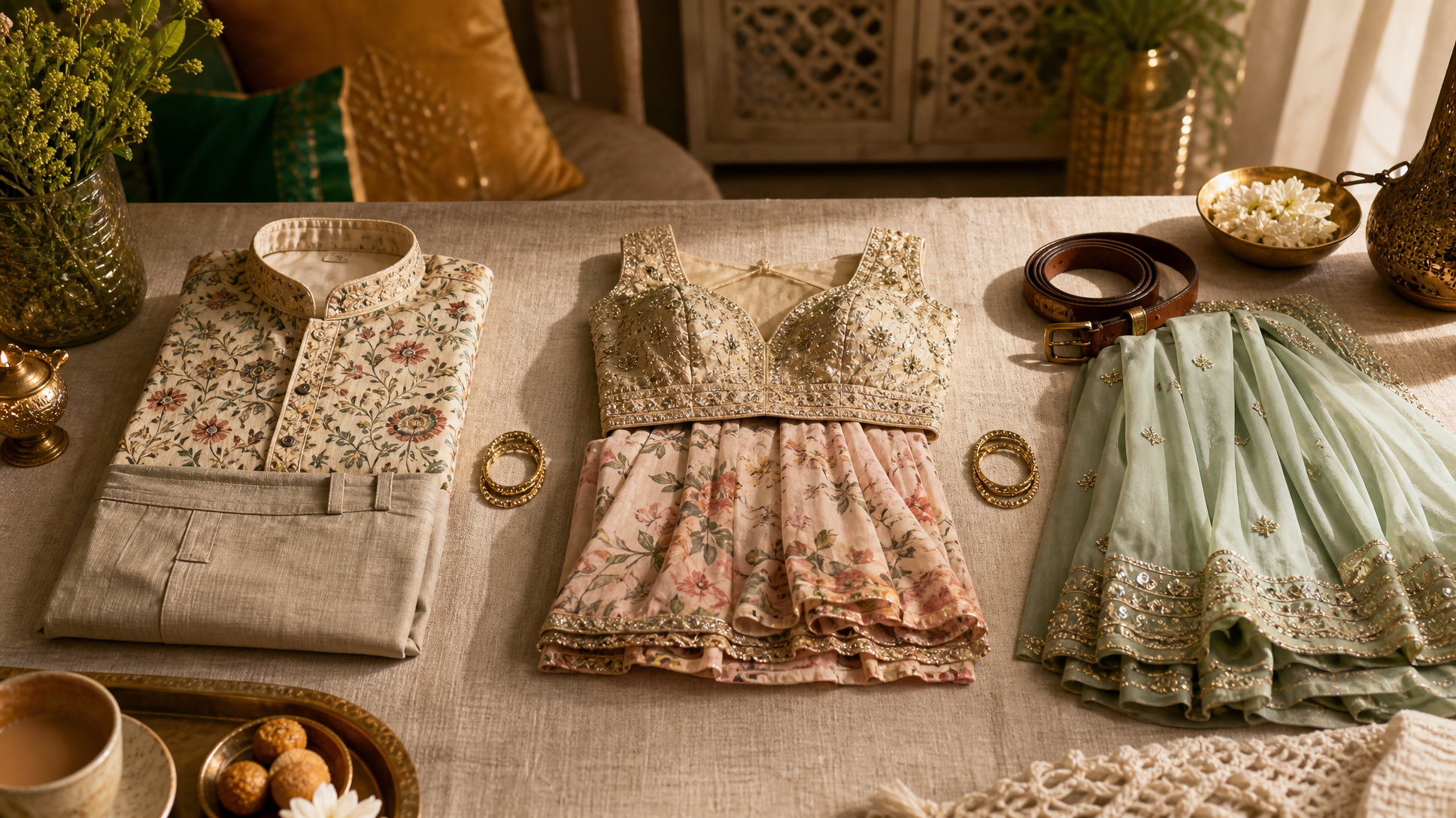
- A structured saree blouse paired with a flowy Western maxi skirt instead of a traditional drape
- A long anarkali kurta cinched with a Western belt and worn with straight-cut pants
- A kurta set where the dupatta is styled as a stole over a blazer rather than draped traditionally
What these share: the Indian piece is still clearly the hero. The Western element doesn't overpower it — it sharpens it.
The wedding guest problem
Weddings are where Indo-Western dressing gets tricky. The stakes are higher — you want to look festive, not underdressed — and the line between "fashion-forward" and "confused" is thinner than it seems at a casual party.
The most common mistake: treating Indo-Western as a relaxed dress code rather than an elevated one. Pairing a heavily embellished kurta with distressed jeans, for instance, creates a tension that reads as unfinished rather than intentional. The fabrics are fighting each other. The occasion levels don't match.
The fix is simpler than it sounds: match the formality of both pieces, not just the aesthetic.
A practical framework: three pairings that actually work for a wedding
1. The printed kurta over tailored trousers
This is the most accessible starting point, especially for women who want to look dressed up without committing to a full lehenga or saree. The kurta should be mid-length to long — something with some structure, a defined hem, and ideally a fabric that has a little weight to it (rayon, linen, georgette). The trousers should be straight-cut or wide-leg in a solid, neutral tone that picks up one colour from the kurta's print.
What makes it wedding-appropriate: the kurta does the festive heavy lifting. The trousers keep it polished. Add block-heeled sandals and minimal gold jewellery, and you're done — no dupatta required unless you want one.
A straight kurta in a botanical or floral print, like the kind of linen or rayon styles you'll find at India Ethnicity, works particularly well here because the print gives you the Indian identity without needing heavy embroidery to signal "occasion."
2. The saree blouse with a Western skirt
This one looks more editorial, and it takes a little more confidence to wear — but when it works, it really works. The saree blouse (or a structured crop top in a similar silhouette) is inherently Indian in its cut and embellishment. Pair it with a full, flowy skirt — something in a solid or subtly textured fabric — and the combination reads as intentional fusion rather than costume.
The key: the skirt's colour should either match the blouse's base or pick up one accent colour from its embroidery or border. If the blouse is doing a lot visually, the skirt should be doing very little. One piece leads; the other follows.
3. The anarkali with a belt and straight trousers
An anarkali kurta is already a dramatic silhouette — flared, floor-grazing, festive. The Western intervention here is subtle: swap the churidar or palazzo that typically accompanies it for clean, straight-cut trousers in a matching or tonal shade, and add a slim belt at the waist to define the silhouette. The result looks more structured and contemporary than the traditional pairing, without losing any of the occasion-dressing energy.
A black georgette anarkali set, for instance, is versatile enough to be styled this way for a cocktail reception or a more relaxed wedding lunch.
The details that make or break the look
Fabric harmony matters more than colour matching. Indian ethnic fabrics — georgette, chanderi, silk, rayon with a good drape — have a specific weight and movement. Pair them with Western pieces in fabrics that behave similarly: crepe trousers, a satin skirt, a linen wide-leg pant. Denim, jersey, and stiff cotton tend to clash in texture even when the colours are fine.
Keep your jewellery rooted in one tradition. If the Indian piece is leading, go with Indian jewellery — jhumkas, bangles, a maang tikka if the occasion calls for it. Don't split the difference by wearing both a statement Western necklace and traditional earrings. It dilutes both.
Footwear is where people often undo a great outfit. Kolhapuris, block-heeled juttis, or strappy heeled sandals all work well. Chunky sneakers and ankle boots rarely do at a wedding, regardless of how fashion-forward the rest of the look is.
What Indo-Western is not
It's not an excuse to wear whatever you already own. "I'll just throw a dupatta over this" doesn't make a Western outfit Indo-Western — it makes it a Western outfit with a dupatta. The fusion has to happen at the level of the garment and its cut, not just the accessories.
It's also not inherently less formal than traditional wear. A well-assembled Indo-Western look for a wedding can be just as dressed-up as a lehenga — it's a different kind of dressed-up, not a lesser one.
Building your look from the pieces up
The easiest way to start is to anchor the look in one strong Indian piece — a kurta, a blouse, an embellished top — and build outward from there. Let that piece set the colour palette, the formality level, and the fabric story. Then find one Western piece that supports rather than competes with it.
You don't need to buy an entirely new wardrobe. Most Indo-Western looks are built from two or three pieces, and the Indian piece is usually the one doing the most work. That's where it's worth investing.
Find the kurtas, ethnic sets, and separates you need to build your Indo-Western look at India Ethnicity — a wide range of styles shipped directly from India to the USA, so you're not limited to whatever happens to be in stock at a local store.
Frequently Asked Questions
Is Indo-Western wear appropriate for a traditional Indian wedding?
As a guest, yes — especially for events like the cocktail party, mehndi, or sangeet, where dress codes tend to be more relaxed. For the main wedding ceremony or reception, check the dress code on the invitation. If it says "Indian formal" or "traditional," a full lehenga or saree may be more appropriate. If it says "Indo-Western" or "smart ethnic," a well-assembled fusion look is absolutely right.
Can men wear Indo-Western outfits to a wedding too?
Absolutely. For men, Indo-Western typically means a kurta worn with tailored trousers instead of churidar or pyjama, sometimes with a blazer layered over it. A well-fitted kurta in a festive fabric over slim trousers and leather shoes is one of the easiest and most polished wedding guest looks there is.
What's the difference between Indo-Western and fusion wear?
They're largely used interchangeably in Indian fashion. "Fusion wear" is a broader term that can include any blending of cultural aesthetics — not just Indian and Western. "Indo-Western" is more specific: it refers to combinations that draw from Indian ethnic tradition and Western contemporary fashion. In practice, if someone says either term in the context of Indian fashion, they mean the same thing.
Do I need to buy matching sets, or can I mix separates?
Mixing separates is actually the point of Indo-Western dressing — you're combining pieces that weren't designed as a set. The key is to be intentional about it: match fabrics by weight and drape, and make sure the colour story is coherent (either tonal, or a clear print-and-solid pairing). A matching set can also be styled in an Indo-Western way by swapping out one piece, like replacing the dupatta with a blazer or the churidar with tailored trousers.