

The First-Time Saree Wearer's Checklist: How to Buy, Prepare, and Actually Wear One Without Help
You've got a wedding, a Diwali gathering, or a family puja coming up, and you want to wear a saree. You've wanted to for years, honestly. But every time you get close to buying one, the questions pile up: What fabric? What length? What about the blouse? And the big one — how do you actually drape it when there's no aunt nearby to rescue you at 7 a.m.?
This is exactly the situation a lot of second-generation Indian Americans and non-Indian saree enthusiasts find themselves in. The saree is one of the most beautiful garments in the world, but it has a learning curve that nobody warns you about until you're standing in front of a mirror with six yards of fabric and thirty minutes before you need to leave.
This guide is for you. Let's go through it step by step — buying, preparing, and wearing — so you actually show up feeling great, not frantic.
Step One: Choosing the Right Saree to Start With
Not all sarees are equal when it comes to ease of draping. A heavily embroidered silk saree is stunning, but for a first-timer draping solo, it's a genuinely hard place to start. The fabric is slippery, the weight is unforgiving, and any mistake in the pleats shows immediately.
For your first saree, prioritize fabric that grips itself slightly and doesn't slide out of a petticoat tuck. Cotton, linen, and georgette are all good starting points. Cotton and linen have natural texture that holds pleats well; georgette is slightly flowy but light enough to manage. Chiffon is beautiful but tends to slip — save it for when you've had more practice.
Rayon and blended fabrics are also worth considering. They drape softly, stay in place better than pure silk, and are generally more forgiving if your pleats aren't perfectly even.
If you want a deeper look at how different fabrics behave for different occasions and climates, this guide to saree fabrics and styles breaks it down in detail.
Pre-Stitched vs. Traditional: The Question Everyone Asks First
A pre-stitched (or ready-to-wear) saree is exactly what it sounds like — the pleats are already sewn in, and it fastens like a skirt. You step into it, hook or tie it, and drape the pallu (the decorative end) over your shoulder. Done in under five minutes.
A traditional saree is a single length of unstitched fabric — usually around five to nine yards depending on the regional style — that you drape fresh each time you wear it.
Should you start with pre-stitched? Honestly, it depends on what you want from the experience. If your goal is to show up at an event looking put-together without a two-hour practice session, a pre-stitched saree is a completely legitimate choice. There's no shame in it — plenty of experienced saree wearers choose them for convenience.
But if you want to learn the traditional drape — and many first-timers do, because it feels more meaningful — then a traditional saree is absolutely doable solo. It just requires practice, which we'll get to.
The Blouse Situation (Don't Skip This)
The blouse — called a choli — is the fitted top worn underneath the saree. Most sarees come with unstitched blouse fabric (called blouse piece), which means you'll need to get it tailored separately. Some sarees come with a ready-made blouse, which is far more convenient for first-timers.
When buying online, check the product listing carefully:
- Does it include a blouse piece or a ready-made blouse? If it's just blouse fabric, factor in tailoring time — at least two to three weeks before your event.
- What size is the ready-made blouse? Blouse sizing in Indian ethnic wear often runs smaller than Western sizing. Measure your bust carefully and compare it to the size chart provided.
- What's the back style? A simple hook-and-eye back is much easier to manage alone than a tie-back style, especially if you're dressing solo.
If tailoring isn't an option for you right now, look for sarees that come with a stitched blouse in your size — or consider pairing your saree with a fitted top in a complementary color as a modern alternative.
What Else You'll Need Before the Event
The saree itself is only part of the equation. Here's what to have ready:
- Petticoat (underskirt): This is non-negotiable. The saree tucks into the petticoat waistband, so without it, nothing stays in place. It should be in a color that matches or blends with your saree — not white under a sheer fabric. The fit matters: it should sit snugly at your natural waist, not your hips.
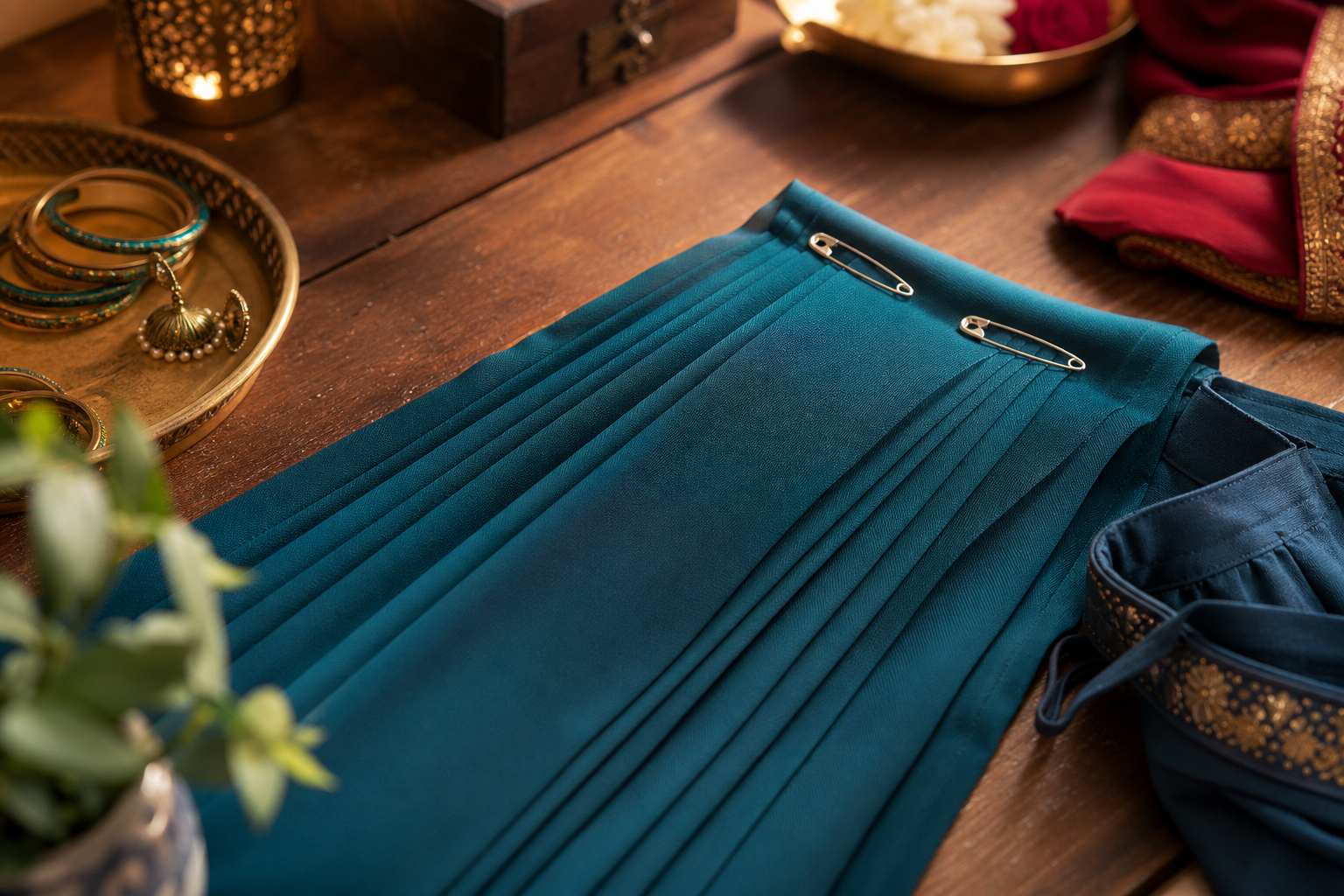
- Safety pins: At least six. They are your best friend. Pin the pallu to your blouse shoulder, pin the pleats at the waist, and pin anywhere that feels uncertain. Small, flat safety pins work best — they're less visible and less likely to snag delicate fabric.
- Double-sided fashion tape: Optional but genuinely useful for keeping the pallu in place on slippery fabrics.
- The right shoes: Heels (even a small block heel) make draping easier because they give you the height to keep the saree off the floor. If you're going flat, hem the saree mentally — the fabric should just graze the floor, not drag.
Practice. Seriously, Practice.
The single biggest mistake first-time saree wearers make is wearing it for the first time on the actual day. Don't do this to yourself.
Drape the saree at least twice before your event — ideally in the same shoes you'll wear that day. The first time will feel chaotic. The second time, you'll know which step confused you and you'll fix it. By the third time, your hands will remember what to do.
The standard Nivi drape (the most common style across India) follows this basic sequence: tuck one end into the petticoat, wrap it around once, make the pleats at the front, tuck the pleats in, bring the remaining fabric around the back, and drape the pallu over the left shoulder. There are excellent step-by-step video tutorials available for free — search for "Nivi saree draping tutorial" on YouTube and follow along with your actual saree, not just watching.
One practical tip: drape it in front of a full-length mirror if you have one. It lets you catch uneven pleats and adjust the pallu fall before you finalize the pins.
On the Day: A Few Things That Help
Give yourself more time than you think you need. Even after practice, getting dressed in a saree takes longer than Western clothes. Build in a buffer.
Wear your blouse and petticoat first, fully adjusted and comfortable, before you start draping. The petticoat drawstring should be tight enough that it won't slip but not so tight it's uncomfortable for hours of sitting, eating, and dancing.
Once you're draped and pinned, do a few movement tests before you leave: sit down, stand up, walk up a step, reach for something. If anything shifts dramatically, add another pin. A well-pinned saree will stay put through a full evening.
And if a pleat comes loose mid-event? Find a quiet corner, tuck it back in, and re-pin. It happens to experienced wearers too. Nobody is watching as closely as you think they are.
Shopping for Your First Saree Online
Buying a saree from abroad — when you can't feel the fabric or see the fall in person — requires a bit more care. A few things to look for in any online listing:
- Fabric description: Look for explicit fabric names (georgette, cotton, linen, rayon) rather than vague terms like "soft fabric." The fabric determines how the saree drapes and how manageable it is.
- Length: Standard saree length is around 5.5 meters, which is suitable for most heights. Some regional styles are longer. Check the listing.
- Blouse details: Confirm whether a blouse is included, what type, and what sizes are available.
- Customer photos: If the platform shows photos from real customers, look at how the saree falls and whether the color matches the product image.
India Ethnicity ships sarees directly from India to the US and other international destinations, which means you're getting the real thing — not a watered-down export version. Browse the saree collection and filter by fabric type to find something that matches where you're starting.
If you're curious about the broader world of saree styles and regional traditions before you buy, this guide to traditional Indian saree types is a good read — it'll help you understand what you're looking at when you browse.
You Don't Need to Be an Expert to Wear One
The saree has been worn by women across the Indian subcontinent for thousands of years — by farmers, by queens, by office workers, by brides. It was never meant to be an elite skill. It was just clothing, worn daily, learned by watching and doing.
You're learning it a little later, in a different country, without someone to show you in person. That's a different situation, not a harder one. Practice twice, pin well, and wear it with the confidence that you chose to show up in something meaningful. That's the whole point.
Ready to find your first saree? Explore India Ethnicity's saree collection — look for beginner-friendly fabrics like georgette, cotton, and linen, and check whether the listing includes a ready-made blouse to keep things simple. Shipped directly from India, so what you're getting is the real thing.
Frequently Asked Questions
What is the easiest saree fabric for a beginner to drape?
Cotton and linen are generally the easiest because their natural texture helps the fabric grip itself and hold pleats without slipping. Georgette is another good option — it's lightweight and manageable. Avoid pure silk or chiffon for your first attempt, as both tend to slide and are less forgiving of uneven pleats.
Can I wear a saree without knowing how to drape it traditionally?
Yes — pre-stitched sarees are a practical alternative where the pleats are already sewn in and the saree fastens like a skirt. They look identical to a traditionally draped saree from the outside and take only a few minutes to put on. Many experienced wearers choose them for convenience, so it's a completely valid option.
How do I figure out my blouse size when buying a saree online?
Measure your bust in inches and compare it to the size chart in the product listing — Indian ethnic wear sizing often runs smaller than standard Western sizing, so don't assume your usual size will translate directly. If the saree comes with unstitched blouse fabric rather than a ready-made blouse, you'll need to factor in tailoring time before your event.
How many safety pins do I actually need to keep a saree in place all day?
Plan for at least six: one or two to secure the pallu to your blouse at the shoulder, two or three to anchor the front pleats at the waistband, and one or two for any spots that feel loose after you've done your movement test. Small, flat safety pins are less visible and less likely to snag delicate fabric than larger ones.