

Rent or Buy? How to Actually Decide When You're Shopping for an Indian Wedding Outfit in the USA
The question that hits every time a wedding invite lands in your inbox
You open the invitation, feel genuinely excited, and then immediately start dreading the outfit decision. Not because you don't know what you want, but because you're in the USA and the options are nothing like walking into a store in Jaipur or Chandni Chowk. Someone in your family group chat will inevitably say "just rent something" — and someone else will say "just buy, you'll wear it again." Neither person has actually done the math for where you live.
So let's do it properly.
What rental actually looks like for Indian wedding outfits in the USA
Rental for South Asian occasion wear exists in the US, but it's concentrated in specific cities — think the New York metro area, parts of New Jersey, Houston, the Bay Area, and a handful of other metros with large South Asian communities. If you're not near one of those hubs, your realistic rental options shrink fast, often to online-only services that ship the outfit to you and expect it back within a few days of the event.
Here's what rental services typically do well: access to heavily embellished lehengas or sherwanis that would be expensive to buy outright, and the appeal of wearing something you'd never reach for again. If you're attending one wedding this year, it's a genuinely reasonable option — on paper.
But here's what the rental pitch tends to gloss over:
- Fit is almost always a compromise. Rental pieces come in standard sizes and aren't tailored to you. A lehenga that sits slightly off at the waist or a kurta that's a centimeter too long in the sleeve is fine in a photo but uncomfortable for a six-hour wedding.
- Turnaround timelines are tight. Many rental services require the outfit back within two to four days of the event. If the wedding runs into a weekend, you're rushing to repackage and ship on a Monday morning.
- Damage deposits and cleaning fees are real. One accidental spill of biryani or a hem that catches on a chair leg can turn a rental into an expensive lesson.
- Selection is curated, not comprehensive. You're choosing from what's available and in your size at that moment — not from a full range of styles, fabrics, and colors.
The honest math of buying for the diaspora shopper
The case for buying gets stronger the moment you count your actual events. If you're part of the Indian diaspora in the US, chances are your social calendar isn't just one wedding. It's a wedding, then Diwali, then a friend's engagement party, then a colleague's mehndi, then Eid or Navratri depending on your community. A well-chosen ethnic piece doesn't sit idle — it rotates.
The other factor people underestimate is the cost of buying in the USA versus sourcing directly from India. Boutiques in the US that stock South Asian occasion wear often carry significant markups because of import costs and retail overhead. That's where buying from a store that sources directly from India changes the math — you're getting authentic pieces at prices closer to what you'd actually pay if you were shopping back home, without the logistical headache of asking a relative to pack a lehenga into their suitcase.
For a diaspora shopper attending two or more Indian occasions a year, buying an affordable, versatile piece almost always works out to be the smarter financial decision — and you get something that actually fits, that you can have tailored if needed, and that you own outright.
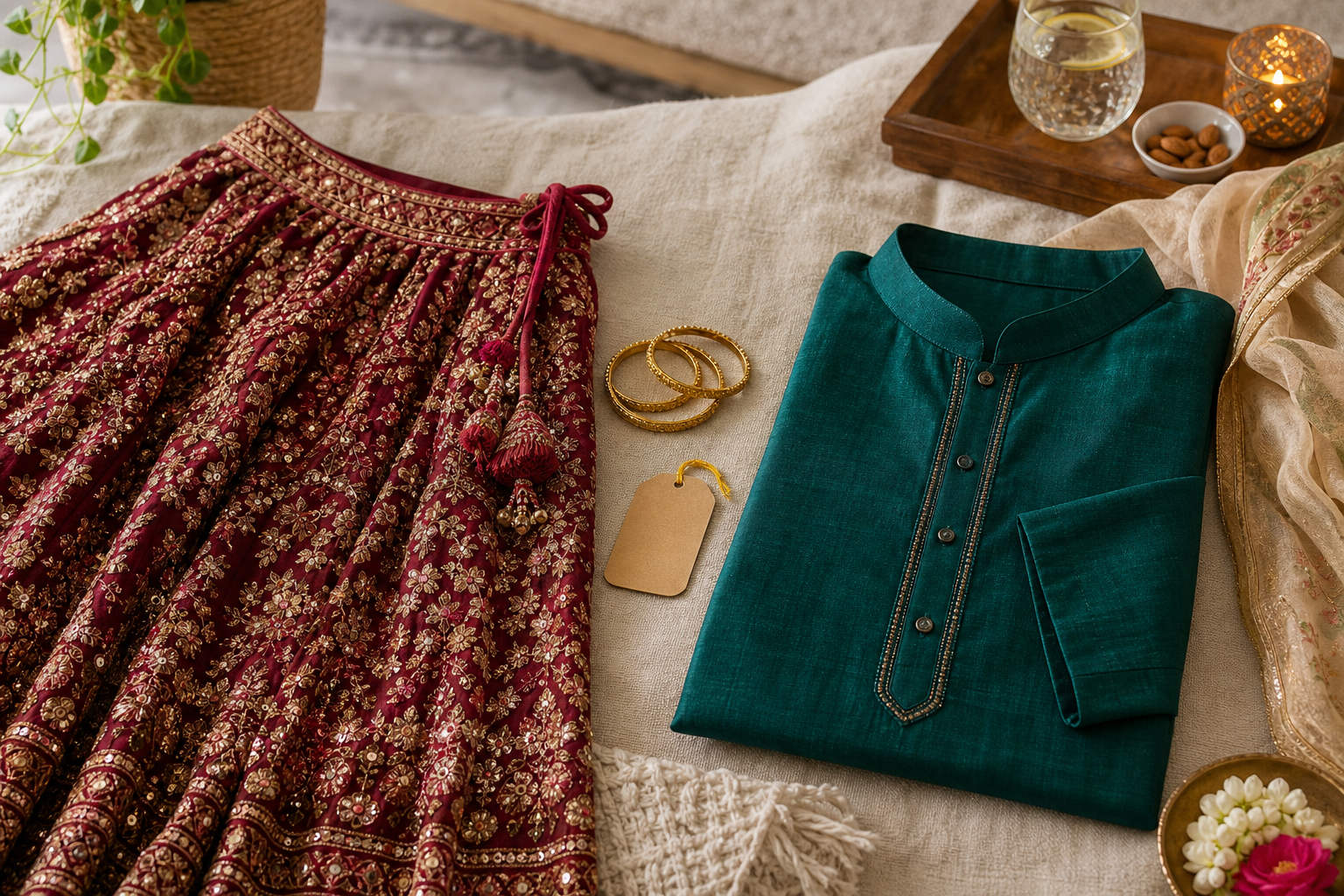
When renting genuinely makes sense
There are real scenarios where renting wins. If this is a one-off — say, you're attending a colleague's wedding and Indian occasions aren't a regular part of your life — then buying a heavily embellished lehenga you'll wear once doesn't make much sense. Rental is also worth considering if you want to wear something extremely high-end (think bridal-adjacent) for a one-time occasion and the piece is genuinely out of your buying budget even at accessible price points.
One more scenario: if you already have a wardrobe of ethnic wear and this particular event calls for something dramatically different from everything you own, a rental fills the gap without adding to a closet that's already working hard.
When buying is the obvious call
Buy when any of these are true for you:
- You attend two or more Indian occasions a year — weddings, festivals, pujas, cultural events.
- You want something that actually fits your body, not a standard size someone else returned last week.
- You're shopping for a style that's genuinely versatile — a straight kurta set, an Anarkali, or a saree that can be re-draped and re-styled across multiple events.
- You're buying for a child, because kids' occasion wear gets used repeatedly across the year and grows out before it wears out.
- You want the option to have the piece tailored or altered to your preference.
The sweet spot for diaspora shoppers is buying pieces that sit in the middle ground — beautifully crafted, culturally authentic, but not so over-the-top that they only work for one specific occasion. A well-chosen kurta set or a classic Anarkali in a rich fabric can carry you through a wedding reception, a Diwali party, and a festive family dinner without looking like you recycled the same outfit. That's the kind of versatility that makes buying feel like a genuinely good decision, not just a rationalization.
If you want to think through how to build that kind of flexible ethnic wardrobe, this guide on building a small Indian ethnic wardrobe for every occasion lays it out clearly. And if you're still figuring out which silhouette actually works for the specific event you're dressing for, the kurta vs. Anarkali vs. straight cut breakdown is worth a read before you commit.
A quick decision framework
If you're still on the fence, run through these three questions:
- How many Indian occasions will I attend in the next 12 months? More than two? Buy. One? Rental is worth considering.
- Do I care about fit? If yes, buy — and look for pieces you can have tailored locally if needed.
- What's my budget ceiling? If you're shopping from a store that sources directly from India, the price gap between rental and ownership often narrows considerably. Run the actual numbers before assuming rental is cheaper.
The answer isn't the same for everyone, but for most diaspora shoppers in the US who celebrate Indian occasions with any regularity, owning a few well-chosen pieces is almost always the more practical — and more satisfying — path.
Browse India Ethnicity's collection of Indian wedding outfits — pieces sourced directly from India, shipped to you in the USA, at prices that make owning over renting an easy choice.
Frequently Asked Questions
Are there Indian wedding outfit rental services that ship across the USA?
Yes, some online rental services for South Asian occasion wear do ship nationally, but availability varies significantly by style and size. Most require the outfit returned within a few days of the event, which can be stressful if the wedding falls on a weekend. In-person rental boutiques are generally limited to cities with large South Asian communities.
What styles of Indian wedding outfits are most versatile for repeat wear?
Straight kurta sets, Anarkali suits, and classic sarees in rich but not overly bridal fabrics tend to be the most versatile. They can be restyled with different jewelry and accessories to suit everything from a wedding reception to a Diwali party. Heavily embellished bridal lehengas are beautiful but harder to re-wear without looking like you're dressed for a wedding every time.
Is buying Indian ethnic wear online from India-based stores reliable for USA shoppers?
It can be very reliable when you shop from stores that specialize in international delivery and have clear size guides and return policies. The advantage is access to a much wider range of authentic styles at prices closer to what you'd pay in India, without the boutique markup common in US retail. Reading size charts carefully and checking delivery timelines before an event is key.
Can I get Indian wedding outfits bought online altered or tailored in the USA?
Yes — most Indian ethnic wear in standard cuts (kurtas, Anarkalis, lehengas) can be adjusted by a local tailor. Hemming, taking in the waist, or adjusting sleeve length are all straightforward alterations. It's worth budgeting for a small tailoring cost if fit is important to you, especially for occasion wear you plan to reach for repeatedly.