

Latest Saree Trends for 2026 Weddings: What's Actually Selling for the Diaspora Right Now
The saree question nobody warns you about
You've been to enough Indian weddings in the U.S. to know that the saree you wore three years ago — the heavy silk one your mom packed into your suitcase — felt stunning but left you sweating through the cocktail hour in a climate-controlled banquet hall that somehow still ran warm. Or maybe you've been the opposite: you ordered something light and breezy, showed up, and felt underdressed next to everyone else in structured, embellished looks.
The 2026 wedding season is already shaping up to be one of the biggest in recent memory for the Indian diaspora in the U.S., and the saree choices women are gravitating toward this cycle are noticeably different from even two years ago. Not dramatically different — this isn't a fashion revolution — but the shifts are real, and knowing them before you order saves you from a very expensive mistake.
Fabric is doing the heavy lifting this season
If there's one trend cutting across every other 2026 saree preference, it's this: women shopping for U.S. weddings are choosing fabrics with more intention than ever. The conversation has shifted from "what does it look like" to "what does it feel like at hour four of a reception."
Georgette — both pure and chiffon-blend — is having a strong moment. It drapes beautifully, photographs well under both natural and banquet lighting, and doesn't trap heat the way heavier silks can in a venue that's only partially air-conditioned. Organza with a soft hand is similarly popular, especially for daytime ceremonies and outdoor garden settings, which are increasingly common in warmer U.S. states.
That doesn't mean silk is out. Soft silk and tissue silk are still very much in play for evening receptions and formal sit-down dinners — the key word being soft. The stiff, heavily starched Kanjivaram look, while timeless in India, tends to feel cumbersome when you're navigating a venue you've never been to, sitting through a multi-hour ceremony, or dancing at a reception where the floor isn't quite what you'd find at a five-star hotel in Chennai. Women living in the U.S. have figured this out, and it's showing up in what they're buying.
The border and embellishment story for 2026
Heavy zari borders are giving way to something more considered. The trend right now leans toward contrast borders — a muted or pastel body with a deeper, richer border in a complementary tone — rather than all-over embellishment. This works particularly well in the U.S. context because it photographs cleanly (important when your wedding photographer is shooting in mixed indoor-outdoor light), and it reads as elegant without requiring the full jewellery arsenal that a heavily embellished saree demands.
Gota lace detailing is also having a real moment. It adds texture and a handcrafted quality without the weight of heavy zardozi or stone work, which matters when you're wearing a saree for six or more hours. You'll see it along borders, on the pallu, and increasingly as a scattered motif across the body of the saree rather than just at the hem.
Botanical and nature-inspired prints — florals, leaf motifs, abstract botanical patterns — are performing strongly in the contemporary end of the market. These aren't the bold, large-scale prints of a few seasons ago; the 2026 version is subtler, often tone-on-tone or in a limited two-color palette that feels modern without straying too far from traditional sensibility.
Draping styles that actually work in a U.S. setting
The Nivi drape — the standard pleated-in-front style most people default to — remains the dominant choice, and for good reason: it's the most widely understood, and if you need a friend or family member to help you at the last minute, almost anyone can assist. But two variations are gaining ground specifically among diaspora women.
The pre-stitched or semi-stitched saree has moved from "convenient shortcut" to genuinely accepted choice. If you haven't explored this yet, the post on what a ready-to-wear saree actually is and whether it's worth buying in the USA breaks down the real trade-offs honestly. The short version: for a U.S. wedding where you may not have a saree-draping expert on call, it's a practical choice that no longer carries the stigma it once did.
The butterfly drape and the Bengali drape are also appearing more frequently at U.S. weddings, partly because they're distinct enough to stand out in a room full of Nivi-draped sarees, and partly because they tend to stay in place better through a long evening — something anyone who's ever spent a reception constantly re-tucking their pallu will understand immediately.
Colors that are landing right now
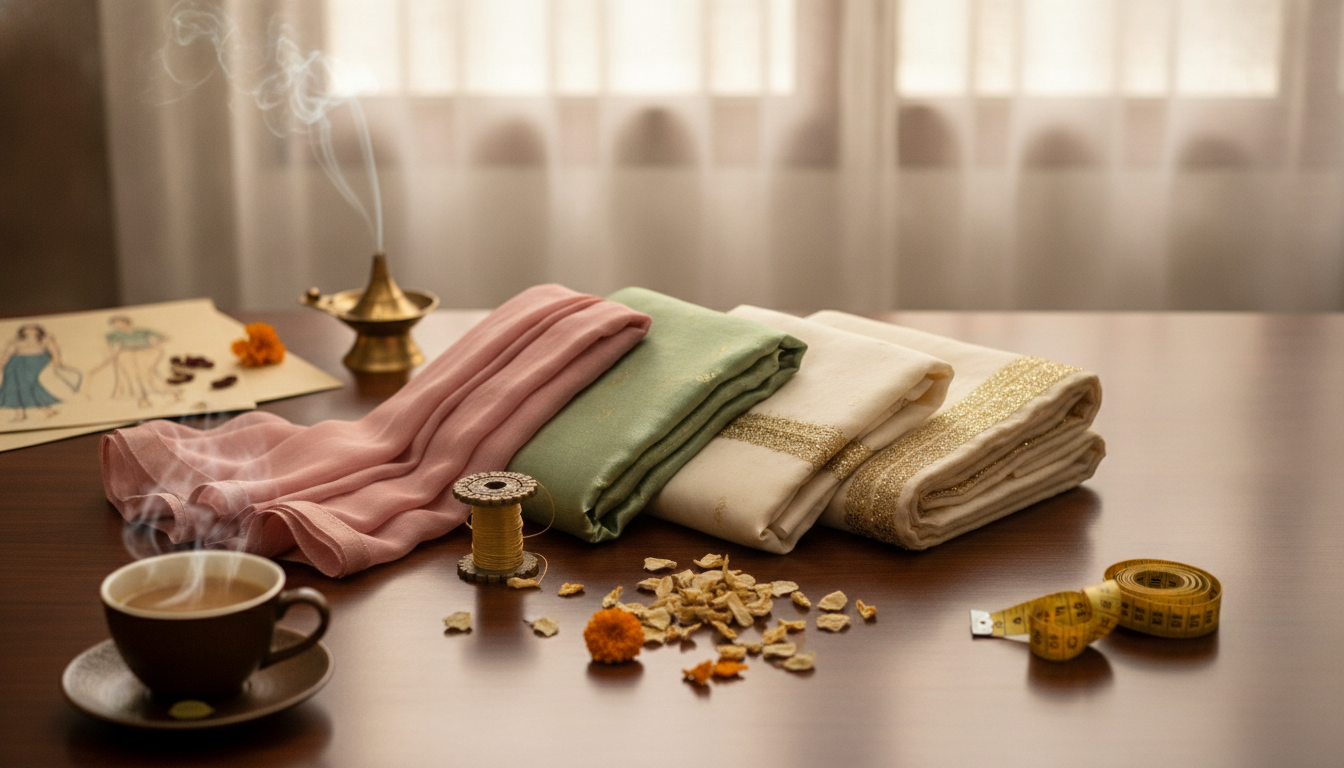
Dusty rose, sage green, and warm terracotta have replaced the saturated jewel tones that dominated a few seasons back. These shades photograph beautifully in the warm, golden-hour light that's become the standard for outdoor wedding shoots in the U.S., and they work across a wider range of skin tones without requiring heavy color correction in post.
Cream and off-white sarees — once avoided because of the traditional association with mourning — have made a strong comeback in the diaspora market, styled with rich contrast borders and bold jewellery. It's a look that reads as bridal-adjacent without competing with the bride, which makes it a smart choice for close family members navigating that tricky dress code.
Deep greens and forest tones are performing well for evening receptions, particularly in georgette and tissue silk. They're formal enough for a sit-down dinner but not as expected as red or fuchsia.
What to think about before you order
A few practical things that the trend conversation usually skips over:
- Blouse lead time matters. Many sarees ship with an unstitched blouse piece. If you need the blouse stitched and don't have a local tailor who works with Indian fabrics, factor that in before you commit to a timeline.
- Venue type changes everything. A garden ceremony in July in Texas is a completely different saree decision than an indoor ballroom reception in New Jersey in December. Fabric weight and draping style should follow the venue, not just the aesthetic.
- Shipping from India takes time. Ordering directly from an India-based collection means you need to plan ahead — especially for wedding season, when demand is high. The post on how to buy Indian clothes online in the USA without getting burned has a practical checklist worth reading before you place any order.
- Draping practice is non-negotiable. Even if you've worn sarees before, wear the specific saree you're buying at least once before the event. Different fabrics drape and hold differently, and finding that out the morning of a wedding is not the discovery you want to make.
For a deeper dive into how to choose the right fabric and style for the specific occasion and season, the guide to choosing saree fabrics and styles for every occasion and climate covers this in real detail.
The bigger picture
What's actually happening with 2026 saree trends for diaspora shoppers isn't a dramatic style pivot — it's a maturation. Women who've been navigating Indian ethnic wear in the U.S. for years are getting more specific about what they need: something that looks authentically Indian, holds up through a long event, photographs well in American light, and doesn't require a support team to wear. The trends that are gaining ground are the ones that meet all four of those criteria at once.
That's a more useful filter than chasing whatever's on the runway.
India Ethnicity's saree collection is sourced directly from India and ships to your door in the USA — browse the full collection at indiaethnicity.com and find the style that actually fits your occasion, your venue, and your timeline.
Frequently Asked Questions
Which saree fabric is best for an indoor U.S. wedding venue?
Georgette and soft chiffon blends tend to work best for indoor venues — they drape fluidly, stay comfortable over long events, and photograph well under artificial banquet lighting. Soft silk and tissue silk are also good choices for formal evening receptions where you want a richer look without the stiffness of heavier silks.
Is a pre-stitched or ready-to-wear saree acceptable for a wedding?
Yes, and increasingly so. Pre-stitched sarees have shed their "shortcut" reputation among diaspora shoppers — especially for U.S. weddings where you may not have someone on hand to drape for you. The look is virtually indistinguishable once worn, and the practicality is real. The trade-off is some loss of draping flexibility, but for most wedding occasions, that's a worthwhile exchange.
How far in advance should I order a saree from an India-based store for a 2026 wedding?
As a general rule, give yourself more time than you think you need — especially during peak wedding season when shipping and processing times can stretch. If the saree comes with an unstitched blouse piece that needs tailoring, add that time on top. Ordering several weeks ahead rather than days is always the safer approach when shipping internationally.
What saree colors work well for a wedding guest who doesn't want to clash with or upstage the bride?
Dusty rose, sage green, warm terracotta, and deep forest green are all strong choices right now — festive and formal without competing with bridal reds, pinks, or whites. Cream and off-white sarees styled with a rich contrast border are also a popular option for close family members, provided the bride isn't wearing white. When in doubt, check with the family about the bridal color palette before you finalize.