

How to Take an Indian Kurta Set from Traditional to Fusion Without Losing What Makes It Ethnic
The outfit that trips most women up isn't the heavily embroidered lehenga or the plain everyday kurta. It's the printed kurta set — the one that's already sitting somewhere in between. Traditional enough for a family function, relaxed enough for a Saturday outing, but somehow never quite styled to its full potential.
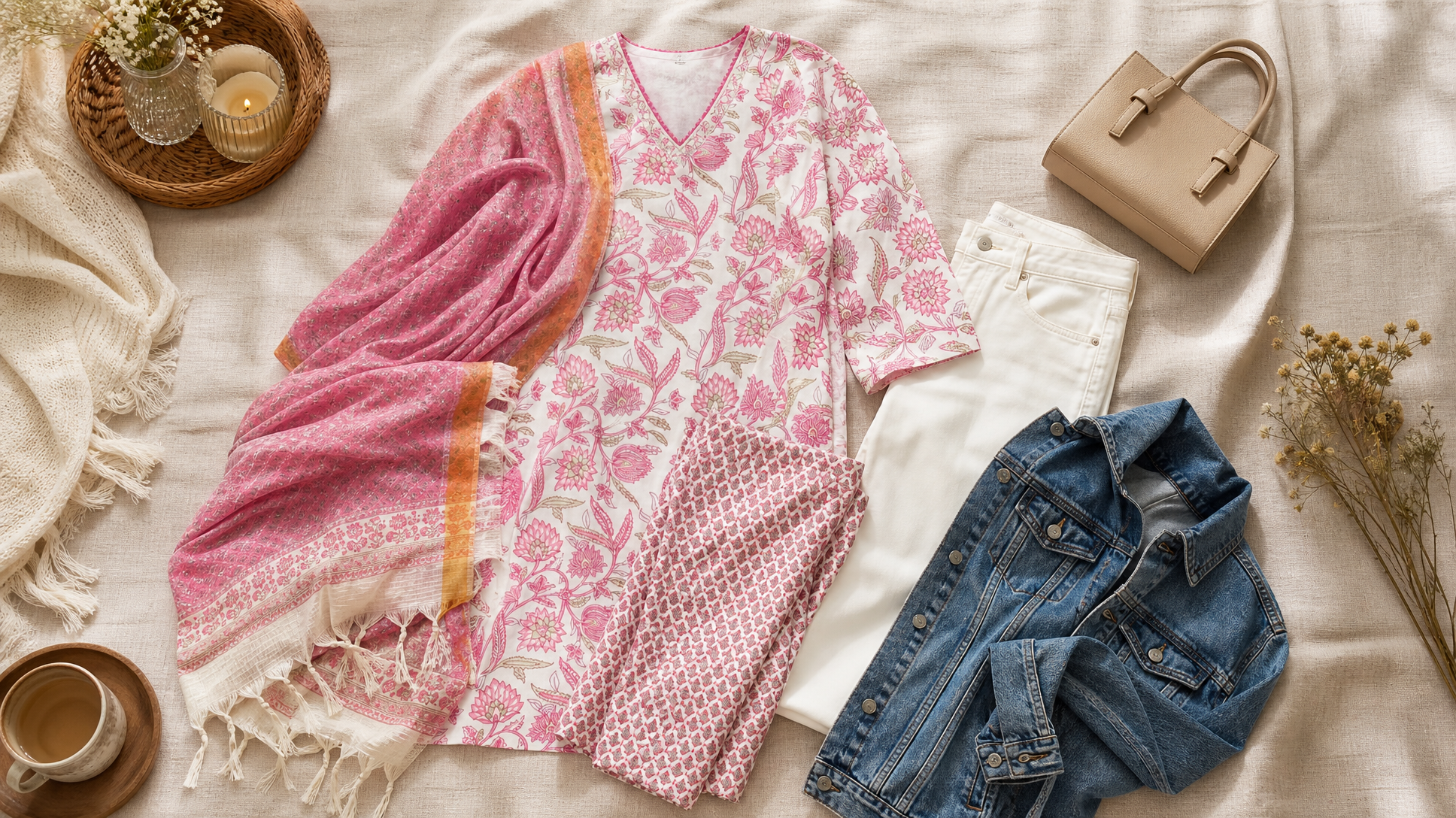
A white and pink floral block-print kurta set like this three-piece — straight-cut kurta with a V-neckline, matching printed straight-leg pants, and a coordinating pink dupatta with an orange border and tassel edges — is actually the easiest starting point for fusion dressing. The silhouette is rooted in Indian ethnic tradition. The print is fresh and contemporary. That combination gives you real room to experiment without the look losing its identity.
But fusion dressing has a failure mode: you pull it too far in one direction and suddenly it reads as either a costume or a confused outfit. This guide is about finding the line and staying on the right side of it.
Why This Particular Set Is Fusion-Ready Already
Block printing is one of India's oldest textile traditions — the floral motifs on a white base are unmistakably ethnic in origin. But the straight-cut silhouette and the V-neckline bring it into a space that Western fashion already understands. You're not fighting the garment to make it fusion. You're just deciding how far to lean.
The three-piece format also gives you options that a single kurta doesn't. The dupatta can stay or go. The pants can be swapped or kept. Each piece is a lever, and pulling different levers gives you a different result — from a full traditional look to something that could walk into a brunch spot in Brooklyn and not feel out of place.
The Fusion Moves That Actually Work
Layer a denim jacket over the kurta
This is the most reliable fusion move in the book, and it works specifically because denim is so neutral. Throw a fitted denim jacket over the kurta — worn open — and the floral print becomes the focal point while the jacket grounds the whole look in something familiar to Western eyes. Keep the printed pants and leave the dupatta off. The result is casual, put-together, and clearly intentional. The ethnic read stays because the kurta's silhouette and print are still doing all the heavy lifting.
One thing to avoid: an oversized or distressed denim jacket. The kurta's straight, clean lines need something equally structured alongside them. A fitted or slightly cropped denim jacket keeps the proportions right.
Swap the straight pants for white jeans or straight-leg trousers
The printed pants that come with this set are beautiful, but they're also the most traditional element of the ensemble. Swapping them for a pair of well-fitted white jeans or crisp white straight-leg trousers does something interesting — it lets the kurta breathe as a standalone statement piece while anchoring the bottom half in something the Western wardrobe already knows how to read.
White works especially well here because the kurta's base is white. The color pulls through from top to bottom, creating a visual line that makes the outfit look deliberate rather than thrown together. Avoid dark-wash jeans — they can make the look feel heavy and muddy against the lightness of the floral print.
Skip the dupatta and carry a structured Western bag
The dupatta is what most clearly signals "traditional Indian outfit" to someone unfamiliar with ethnic wear. Leaving it off immediately softens the traditional read. Pair the kurta and pants (or kurta and white jeans) with a structured tote, a mini shoulder bag, or even a woven rattan bag, and the look shifts comfortably into fusion territory.
That said, don't discard the dupatta entirely — it's a genuinely beautiful piece with its patterned border and tassel edges. Keep it as an option for days when you want the full traditional look, or drape it loosely over one shoulder for a half-and-half approach that still reads as deliberate styling.
Switch up the footwear
Footwear is the quietest lever but one of the most effective. Traditional juttis or embellished sandals keep the look firmly ethnic. Switch to white sneakers and the outfit immediately reads as contemporary. A pair of block-heeled mules lands somewhere in between — dressier than sneakers but more modern than traditional footwear.
For a full fusion look, white sneakers with the kurta, white jeans, and a structured bag is a complete outfit that works for a casual day out without a single piece of the original set being wasted.
The Fusion Moves That Undermine the Ethnic Read
Not every Western styling idea translates. A few common ones actively work against a floral kurta set.
Tucking the kurta into a skirt or pants. A straight-cut kurta with a straight hem is designed to fall freely. Tucking it changes the silhouette entirely and turns it into something that reads as a blouse — which it isn't. The proportions stop working and the ethnic identity of the garment disappears.
Layering a blazer that's too formal. A sharp corporate blazer over a floral block-print kurta creates a tonal mismatch. The print is soft and artisanal; a stiff blazer is boardroom. A relaxed linen blazer or an unstructured cotton blazer can work, but a tailored office blazer usually doesn't.
Pairing with heavily distressed or embellished Western pieces. The floral print is already doing a lot of visual work. Adding ripped jeans, heavily embellished sneakers, or a statement Western belt competes with the print rather than complementing it. Keep the Western elements clean and simple so the kurta remains the focus.
Belting the kurta at the waist. This one comes up a lot in styling guides, and it almost never works with a straight-cut kurta. The kurta's structure and length are designed for an unbelted silhouette. Belting it shortens the visual line awkwardly and bunches the fabric in ways the garment wasn't meant to accommodate.
How to Read the Occasion Before You Style
The beauty of a versatile set like this is that it genuinely covers a range — daily wear, office, casual outings, family functions, and festive occasions are all within reach depending on how you put it together. A useful shortcut: the more Western elements you add, the more casual the look becomes. The more you lean on the original three pieces together, the more formal and traditional it reads.
- Family function or festive occasion: Full three-piece — kurta, matching pants, dupatta draped. Traditional juttis or embellished sandals. Keep accessories ethnic.
- Office or smart casual: Kurta with matching pants, dupatta left off or loosely draped. Block heels or clean flats. A structured bag.
- Casual outing or brunch: Kurta over white jeans, denim jacket, white sneakers, simple tote. No dupatta.
If you're building out a wardrobe that covers multiple Indian occasions and Western settings with fewer pieces, the thinking behind that approach is worth reading through — this guide on building a small Indian ethnic wardrobe walks through the logic in detail.
A Note on Buying the Right Set to Start With
Fusion styling only works if the base garment is well-made enough to hold up across different contexts. A set where the fabric is flimsy, the print is blurry, or the pieces don't coordinate properly will look underdone no matter how thoughtfully you style it. Buyers of this floral block-print set consistently note the good quality fabric and that the product matches what's shown — both of which matter when you're planning to style it multiple ways and wear it often.
If you're shopping for Indian ethnic wear from the USA and want to understand what separates a reliable online purchase from a disappointing one, this practical checklist for buying Indian clothes online is worth a look before you add anything to your cart.
A printed kurta set that's already sitting between traditional and contemporary isn't a compromise — it's a head start. The hard work of bridging two aesthetics is already done in the design. Your job is just deciding how far to take it on any given day.
Start with a kurta set that's already built for both worlds — shop India Ethnicity for floral printed sets that move from traditional to fusion without missing a beat.
Frequently Asked Questions
Can I wear a straight-cut kurta as a dress instead of pairing it with the pants?
It depends on the length. Some straight-cut kurtas are long enough to be worn as a tunic dress over leggings or even alone as a short dress, but this particular set is designed as a coordinated three-piece — the kurta, pants, and dupatta are meant to work together. If the kurta length works for you as a standalone piece over leggings or fitted trousers, that's a valid fusion move, but check the hem length against your own proportions before committing to it.
What jewelry works best when styling a floral kurta set in a fusion way?
For a fusion look, simpler jewelry tends to work better than heavy traditional sets. Delicate gold hoops, small studs, or a single fine chain keep the ethnic warmth without making the look feel overdressed for a casual Western context. If you're wearing the full three-piece traditionally, you have more room to go bold with jhumkas or statement earrings — the dupatta and full ensemble can carry it.
How do I care for a floral block-print kurta set to keep the print from fading?
Block-printed fabrics generally do best with a gentle cold-water hand wash or a delicate machine cycle, turned inside out. Avoid soaking for long periods and skip harsh detergents — they can lift the dye from the print over time. Always check the care label on your specific set for the manufacturer's instructions, as fabric composition affects how you should wash it.
Is a three-piece kurta set appropriate for an Indian wedding as a guest?
A well-styled three-piece kurta set — kurta, matching pants, and dupatta — is a perfectly appropriate guest outfit for many Indian weddings, particularly for daytime functions, mehendi ceremonies, or more casual celebrations. For a formal evening reception or a heavily traditional ceremony, you may want to opt for something with more embellishment. If you're navigating Indian wedding dress codes for the first time, this first-timer's guide to Indian wedding attire covers the full range of occasions and what works for each.