

How to Dress Your Husband (or Dad, or Brother) for an Indian Wedding in the USA: A No-Guesswork Guide to Men's Ethnic Wear
You've sorted your lehenga. You know what the kids are wearing. And then someone asks what the men are putting on — and suddenly it's a whole other conversation that nobody planned for.
If you're the one who ends up making that call (and let's be honest, you usually are), this guide is for you. Not a glossary of Indian menswear terms, not a runway recap — just a clear walkthrough of the actual decisions you need to make when dressing a husband, dad, or brother for an Indian wedding in the USA.
Start Here: What's the Occasion, Really?
Indian weddings aren't one event — they're often three or four, each with a different dress code. A mehendi calls for something relaxed and colorful. The baraat demands a full moment. A reception can go either way depending on how formal the couple wants it. Before you pick a single outfit, nail down which function you're dressing for, because the right answer changes completely.
As a rough guide: daytime functions and pre-wedding events lean toward lighter fabrics and simpler silhouettes. The wedding ceremony and reception are where you can go bolder — richer fabrics, more embellishment, a structured jacket or sherwani if the man is up for it.
Kurta vs. Sherwani vs. Kurta-Jacket Set: The Honest Breakdown
This is the question everyone asks, and the answer is less about tradition and more about the man wearing it.
The Kurta
A well-chosen kurta is the most versatile option and, frankly, the most wearable one for men who don't regularly wear ethnic clothing. It's comfortable, it doesn't require a tailor's fitting, and it looks put-together when paired with the right churidar, palazzo, or straight-cut pants. For men who are skeptical of the whole exercise, a kurta is the path of least resistance — and it's not a compromise. A solid or subtly printed kurta in a good fabric reads as intentional and appropriate at most wedding functions.
The Sherwani
A sherwani is the formal peak of Indian men's wedding wear. It's structured, long, and typically heavily embellished — think the groom's outfit or a close family member who wants to make a real statement. If the man you're dressing is the groom's father, the bride's brother, or someone else in the inner circle, a sherwani makes sense. For a distant relative or a guest, it can actually be overdressed depending on the wedding's overall vibe. Worth asking the couple before committing.
The Kurta-Jacket Set
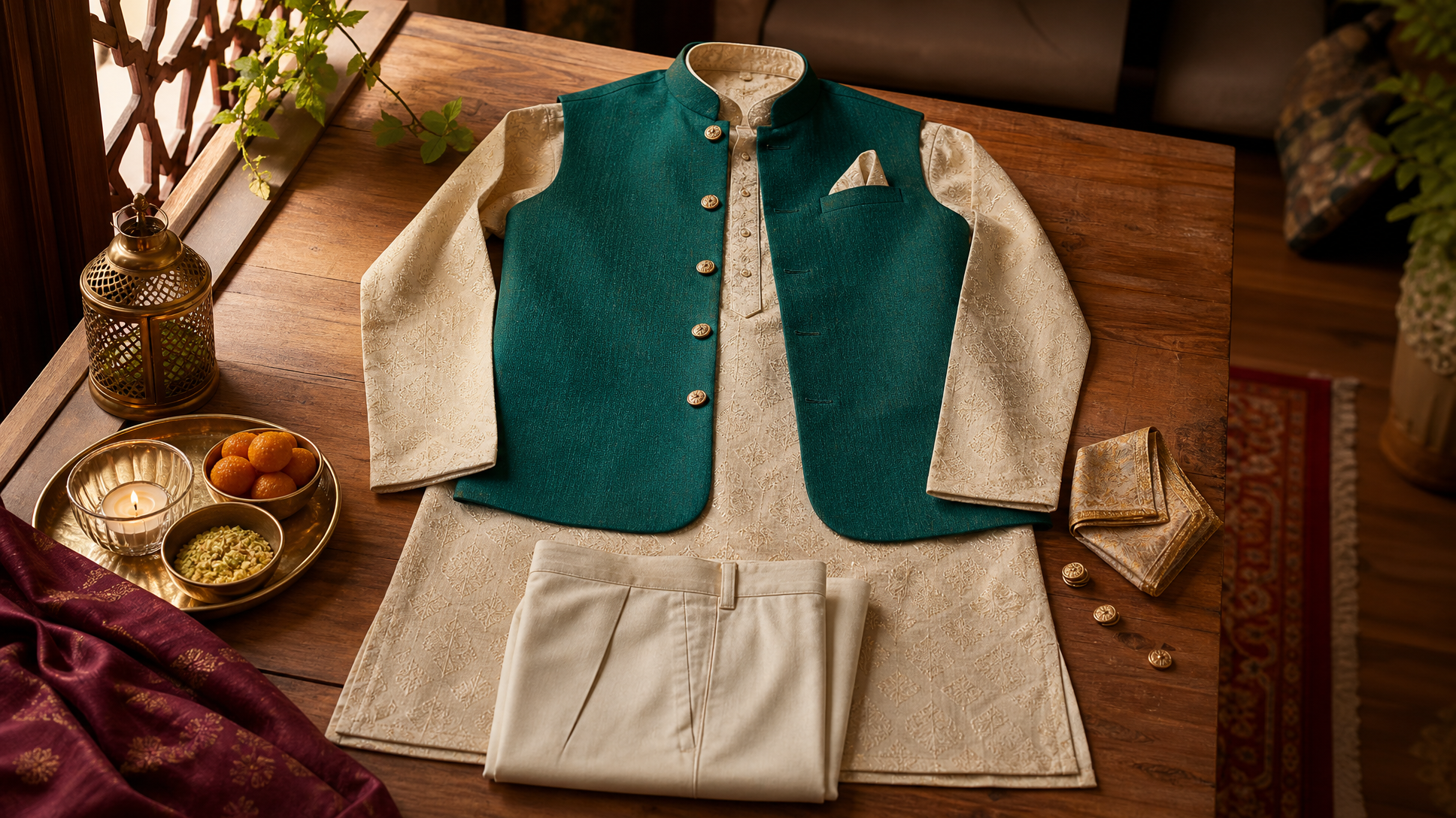
This is the sweet spot that most diaspora families land on, and for good reason. A kurta paired with a Nehru jacket or a structured bandhgala gives you the formality of a sherwani without the full commitment. It layers well, photographs beautifully, and the jacket can come off during a long reception without the whole look falling apart. If you're buying one outfit that needs to work across multiple functions, a kurta-jacket set is almost always the right call.
Fabric: What Actually Holds Up Across a Six-Hour Reception
This is the part most people skip, and then regret by 10 p.m. Indian wedding receptions in the USA often run long — there's food, dancing, photos, more food. The fabric choice matters more than the embellishment.
Cotton and cotton blends breathe well and are forgiving across a long evening, especially in warmer months. They wrinkle more than synthetic fabrics, so they work better for daytime or casual functions than a formal evening reception.
Rayon is lightweight, drapes well, and doesn't wrinkle badly — it's become a go-to fabric for everyday and semi-formal kurtas. For a guest who wants to be comfortable without looking underdressed, a rayon kurta is a solid choice.
Silk and silk blends photograph beautifully and carry the richness that a formal wedding demands. They're warmer to wear and require more care, but for a single evening event, they're worth it if the occasion calls for it.
Georgette and viscose are often used in more festive, embellished pieces. They drape well and add a certain fluidity to the silhouette — you'll often see these in Anarkali-style or heavily embroidered sets.
The practical rule: if the man runs warm or hates feeling restricted, prioritize breathability over richness. A comfortable man in a cotton-blend kurta will look better in photos than an uncomfortable one in silk who's been tugging at his collar all night.
Color: How to Actually Coordinate Without Matching Too Hard
The instinct to match the men's outfits to the women's is understandable, but full matching can tip into costume territory. A better approach is coordinating within the same color family rather than hitting the exact same shade.
If the women are wearing jewel tones — deep green, burgundy, navy — the men can wear a complementary neutral (ivory, cream, beige) or a muted version of the same family. If the women are in pastels, the men can stay in whites, soft greys, or a single accent color that echoes without mirroring. The goal is a family photo where everyone looks intentional, not like they shopped from the same rack.
One practical note: avoid very light colors (white, ivory) for the groom's close male relatives unless the groom himself is wearing white — it can create unintentional visual competition in photos.
Ordering Men's Indian Ethnic Wear Online from the USA: What to Watch For
This is where most of the friction actually lives. The outfit decision is the easy part — getting the right size, delivered on time, is where things go sideways.
Size charts are not universal
Indian ethnic wear sizing does not map cleanly onto US sizing. A man who wears a large in American shirts may need an XL or XXL in a kurta from an Indian brand, depending on the cut and the brand. Always measure chest, shoulder width, and length before ordering, and compare those measurements to the specific size chart on the product page — not a generic chart. When in doubt, size up; a slightly long kurta can be hemmed, but a tight one across the shoulders cannot be fixed.
Check the return and exchange policy before you buy
Because products ship from India, return windows and processes differ from what you're used to with US retailers. Read the policy carefully before placing an order, especially if you're buying multiple pieces or buying well in advance. If you're ordering for an occasion with a fixed date, factor in shipping time and leave yourself a buffer. This practical checklist for buying Indian clothes online in the USA covers the full process if you want to go deeper.
Order earlier than feels necessary
Shipping from India to the USA takes time, and wedding season creates real demand spikes. If the wedding is two months out, order now. If it's six weeks out, order this week. The men's outfit is almost always the last thing anyone thinks about, which is exactly why it ends up being the most stressful part.
Photos help — use them
If the man you're ordering for has worn Indian ethnic wear before and has a photo of himself in it, use that as a reference point for fit and style. If he hasn't, measure him at home before you open a single product page. Getting the measurements first makes every other decision faster.
A Quick Word on Men Who Are New to Ethnic Wear
Some men in diaspora families have worn kurtas since childhood. Others haven't touched one since a wedding fifteen years ago, or have never worn one at all. If you're dressing someone in the second category, keep it simple on purpose.
A straight-cut kurta in a solid color or a subtle print, paired with comfortable straight-leg pants, is easy to wear and easy to feel good in. Avoid heavily embellished pieces for a first-timer — the embroidery can feel unfamiliar and stiff. Once he's comfortable in the silhouette, you can layer in a jacket or move toward richer fabrics for the next occasion. There's a useful guide here on moving between traditional and fusion styling if you want to ease someone into ethnic wear gradually.
For a full breakdown of the men's Indian ethnic wear brands available to shop from the USA and how to compare them before buying, this post walks through exactly that.
The men's outfit doesn't have to be the afterthought. With a clear sense of the occasion, the right silhouette for the man wearing it, and enough lead time to order properly, it's actually one of the easier decisions in the whole wedding wardrobe equation — once you know what you're choosing between.
Browse men's ethnic wear at India Ethnicity — kurtas, kurta sets, and more, shipped directly from India to your door in the USA.
Frequently Asked Questions
Is a kurta appropriate for a formal Indian wedding reception, or is it too casual?
A kurta is absolutely appropriate for a formal reception — the key is in the fabric and styling. A kurta in a rich fabric like silk or a silk blend, paired with a structured Nehru jacket and well-fitted churidar or straight pants, reads as formal and intentional. It's the combination that elevates it, not the garment alone.
How far in advance should I order men's Indian ethnic wear online in the USA?
At minimum, order four to six weeks before the event to account for shipping from India and any potential exchange if the size isn't right. During peak wedding season — typically late spring and fall — demand is higher and shipping can take longer, so ordering eight weeks out is safer. The men's outfit is almost always ordered last, which is exactly why it causes the most last-minute stress.
How do I figure out the right size when ordering a kurta from an Indian brand?
Measure chest circumference, shoulder width, and the length from the shoulder to where you want the kurta to fall — typically mid-thigh. Compare those measurements to the specific size chart on the product page, not a generic Indian sizing guide, since sizing varies by brand. When measurements fall between two sizes, go up. A slightly large kurta can be tailored; a tight one across the shoulders cannot.
Can the same kurta work for multiple wedding functions, or do you need a different outfit for each?
One well-chosen kurta-jacket set can cover multiple functions if you style it differently. Wear the full set — kurta plus jacket — for the formal ceremony or reception, and drop the jacket for a more relaxed daytime event like a mehendi or lunch. Swapping the bottom (churidar vs. straight pants) also changes the formality level. For most guests who aren't in the immediate family, one versatile outfit is entirely sufficient.