

Why Your Saree Never Looks the Way It Does in Photos — and How a Shapewear Petticoat Fixes That
You've draped the saree a dozen times. You've watched the tutorials, pinned it exactly right, and still — something looks off. The fabric bunches at the hip. The pleats don't fall cleanly. The silhouette in the mirror looks nothing like the one on the model. So you blame your technique.
Here's the thing: it's usually not your technique.
What sits underneath your saree shapes everything you see on top. A traditional petticoat — the kind that's been passed down through generations — was designed for a different era of saree fabrics. It did its job beautifully with heavy silks and cotton weaves that have enough weight to drape themselves. But when you're wearing a sheer chiffon, a floaty georgette, or a delicate net saree, that same petticoat becomes the problem. The bulk, the visible waistband, the way it shifts when you walk — all of it shows through, and no amount of re-draping fixes it.
What a Traditional Petticoat Actually Does (and Doesn't Do)
A traditional petticoat gives you something to tuck into and pin against. That's its entire job. It was never engineered to smooth your silhouette, hold compression at the hips, or disappear under sheer fabric. For a heavy Banarasi or a stiff Kanjeevaram, that's fine — the saree's own weight takes over. But for the lighter fabrics that dominate wedding guest looks and festive dressing today, you need the foundation to do more work.
The other issue is fit. Most petticoats are gathered or pleated at the waist, which adds volume right where you least want it — at the hips and stomach. That extra fabric is exactly what creates the bunching you see when a chiffon or organza saree drapes over it.
What a Seamless Shapewear Petticoat Does Differently
The NYKD Seamless Saree Shapewear Petticoat (NYSH01) was built to solve this specific problem. It's a full-length, high-waist shapewear piece in a nude cameo rose tone — seamless by construction, with a fitted silhouette that hugs the body rather than gathering around it. From the photo, you can see the subtle ribbed texture on the upper portion and the clean, smooth line it creates from waist to hem.
A few things it does that a regular petticoat simply can't:
- Seamless finish. There are no bulky seams or gathered waistbands to show through sheer fabrics. Under a net or chiffon saree, this is the difference between a clean drape and a lumpy one.
- Targeted compression at the side hip. The shapewear applies focused compression where it matters most for silhouette — the outer hip — while keeping the center area comfortable so there's no muffin-top effect.
- High-waist support. The waistband extends high enough to support the midsection, hips, and thighs, which means your saree's pleats have a stable, smooth surface to fall against.
- Side slit for movement. This is the detail that separates a shapewear petticoat from a shapewear skirt. The side slit means you can walk, sit, and dance without fighting the fabric — something a tightly fitted piece without a slit simply doesn't allow.
- Stretchable nylon/spandex fabric. It moves with you and springs back, so the shape holds through a full wedding reception or a long pooja, not just the first hour.
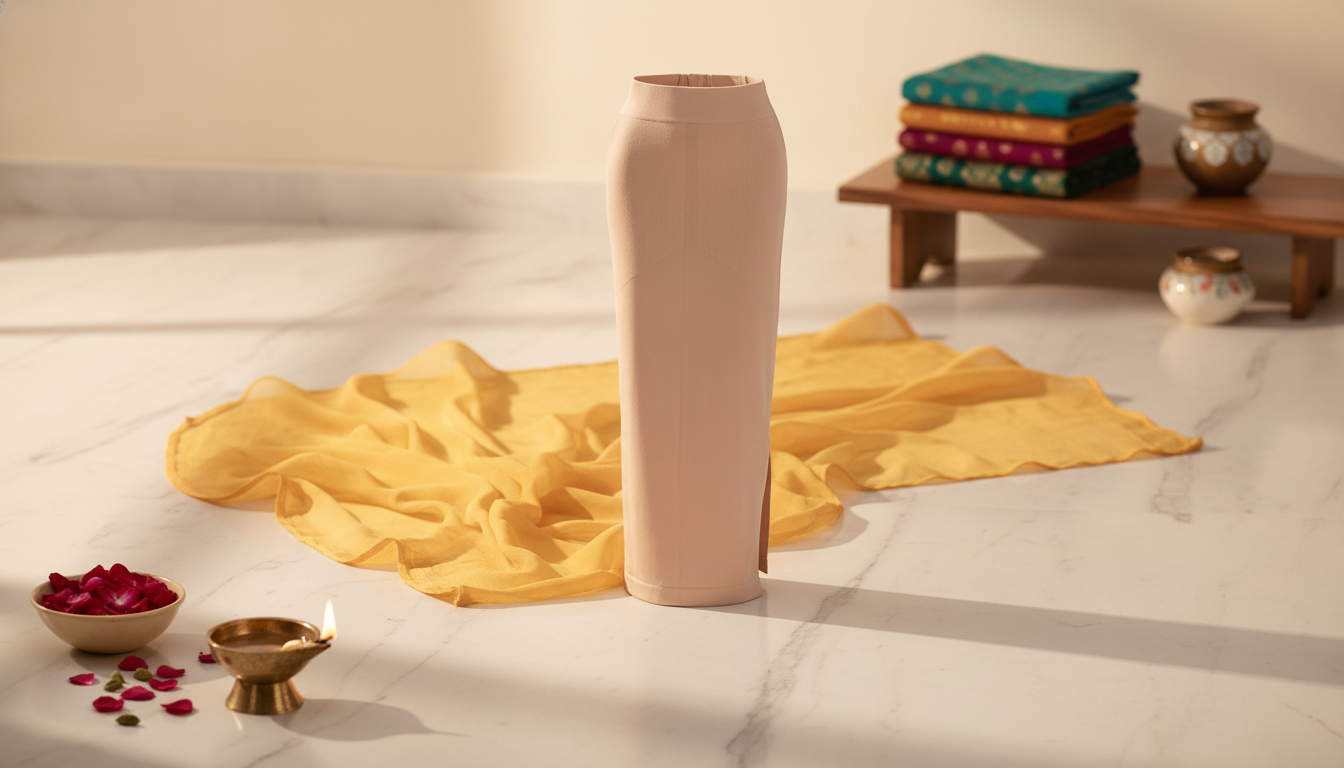
The result is what buyers consistently describe: a smooth, mermaid-like silhouette that looks intentional, not accidental. The saree drapes the way it's supposed to because what's underneath is finally working with it instead of against it.
Which Sarees Benefit Most
If you mostly wear heavy silks, your traditional petticoat is probably fine. But if your wardrobe leans toward any of these, a shapewear petticoat is worth considering:
- Chiffon and georgette — both cling and flow in ways that make every lump underneath visible. A seamless foundation is non-negotiable.
- Net and organza — sheer by design, so anything underneath is essentially on display. The nude cameo rose tone of the NYSH01 is specifically chosen to stay invisible under light fabrics.
- Satin — the shine of satin reflects light and amplifies texture, which means a gathered petticoat shows up clearly.
- Pre-stitched and ready-to-wear sarees — these already have a set drape, so the petticoat's job is purely foundational. A smooth, fitted base lets the pre-stitched pleats fall exactly as they were designed to.
If you're wearing a saree to a wedding or a festive occasion and want it to photograph well — not just look okay in the moment — the fabric underneath matters more than almost any other decision you make.
How to Wear It
Put it on before your blouse. The high waist sits at your natural waist or just above, and the fitted body smooths from there to the hem. Because it's seamless and stretchy, there's no fiddling with drawstrings or hooks — it goes on like a skirt and stays put. Drape your saree over it exactly as you normally would; the difference is that you'll have a stable, smooth surface to tuck into and pin against, and the fabric will fall cleanly instead of catching on gathered cotton.
The side slit sits at the front or can be rotated to the side depending on your preference — it gives just enough ease that walking in a fitted saree doesn't feel restrictive.
For anyone who's been curious about what to wear under a ready-to-wear saree, this is the answer most stylists in India have quietly switched to. And if you're still deciding between a pre-stitched and a traditionally draped saree, this guide on ready-to-wear sarees breaks down the trade-offs honestly.
One Thing to Know Before You Size
Shapewear sizing is not the same as your regular clothing size. Because the fabric is meant to compress and shape, sizing up when you're between sizes usually gives you a more comfortable result — especially if you're wearing it for several hours at a wedding or a long event. The stretchable nylon/spandex blend has good recovery, but too-tight shapewear will roll down at the waist or dig in at the hip, which defeats the purpose entirely.
Your saree probably looks better than you think. It just needs a better foundation.
Shop the NYKD Seamless Saree Shapewear Petticoat in Nude on India Ethnicity and get the silhouette your saree deserves.
Frequently Asked Questions
Can I wear this shapewear petticoat under any saree, or only specific fabrics?
It works under any saree, but it makes the biggest difference under lightweight and sheer fabrics — chiffon, georgette, net, organza, and satin — where a traditional petticoat's bulk tends to show through. Under heavier silks, either option works, though many women still prefer the shapewear for the smoother silhouette it creates.
Will the nude color show through a light-colored or white saree?
The cameo rose nude tone is designed to stay as invisible as possible under light fabrics, which is why it's the standard choice for sheer sarees. For very pale or white sarees, it will always be less visible than a bright white or colored petticoat. That said, the seamless construction — no gathered fabric, no visible seams — does most of the work in keeping it hidden.
How is this different from regular shapewear shorts or a shaping skirt?
Regular shapewear shorts end at the thigh, which means the saree fabric has nothing smooth to drape against below the knee — you'd still need a petticoat on top. A shaping skirt without a slit restricts your stride significantly, especially in a fitted saree. The NYKD shapewear petticoat is full-length, so it gives you a smooth surface all the way to the hem, and the side slit means you can actually move in it.
Can I use it as a standalone skirt for a fusion look?
Yes — the full-length fitted silhouette and neutral nude tone make it easy to style as a base for fusion outfits, paired with a longer kurta or a structured top. It's not just an undergarment; several buyers wear it as a skirt layer for casual or contemporary Indian looks.